
Have you ever wondered how SEO work to make websites appear at the top of search results on Google? SEO, or Search Engine Optimization, helping search engines understand your website so it reaches the right audience. By optimizing your site’s content, structure, speed, and keywords, SEO bridges the gap between what people are searching for and the solutions your website offers.
In simple terms, mastering how SEO work can make it easier for potential customers to find you, trust your brand, and take meaningful action. SEO is like a roadmap for search engines — the better your path, the higher your site climbs.
What is SEO?
SEO (Search Engine Optimization) is the process of improving your website’s visibility in search engine results pages (SERPs) — like Google, Bing, or Yahoo.
The main goal of SEO is to help search engines understand your content so they can show it to the right audience.
When done correctly, SEO helps you:
- Attract organic (free) traffic
- Increase your brand visibility
- Build trust and credibility online
How Search Engines Work
Search engines like Google, Bing, and Yahoo act as digital librarians of the internet. Their job is to help users find the most relevant and useful information among billions of web pages. When you type a query — like “best pizza near me” or “how to start a blog” — these search engines instantly scan through their vast database to deliver the most accurate results within seconds.
Explanation of Crawling, Indexing, and Ranking

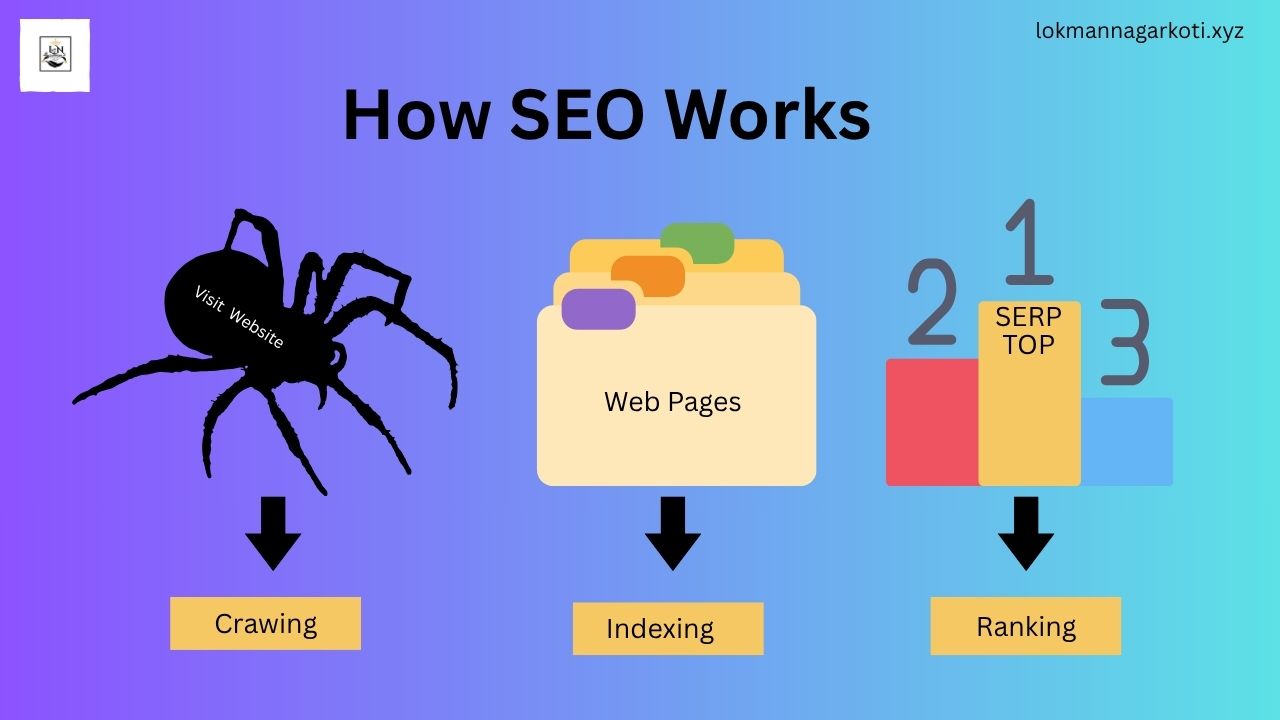
To understand how SEO works, you first need to know how search engines process information. This happens in three main stages:
Crawling
Search engines use automated bots, often called “spiders” or “crawlers,” to explore the web. These bots visit websites, follow links, and collect information about each page, including content, structure, and keywords.Indexing
Once the pages are crawled, the data is stored in a massive database known as the index. Think of it as a digital library catalog. When your website is indexed, it means Google has recognized it and can show it in search results when relevant queries are made.Ranking
After indexing, search engines rank the pages based on hundreds of factors — like keyword usage, content quality, backlinks, page speed, and user experience. The higher a page’s relevance and authority, the better its chances of appearing at the top of search results.
In short
Crawling = Finding content
Indexing = Storing content
Ranking = Displaying the best content first
The 3 Main Types of SEO
The three main types of SEO are explain below;
1. On-Page SEO
This focuses on what you can control on your website:
- Optimize titles, meta descriptions, and headings
- Use target keywords naturally
- Add internal links
- Optimize images (alt text, file size)
- Improve user experience (UX)
2. Technical SEO
This involves making your website technically sound so search engines can crawl and index it easily:
- Ensure fast page loading speed
- Use mobile-friendly design
- Fix broken links
- Set up SSL (HTTPS)
- Create an XML sitemap
3. Off-Page SEO
Off-page SEO focuses on building your site’s reputation and authority outside your website:
- Earn backlinks from reputable sites
- Promote content on social media
- Build brand mentions
How Keywords Work in SEO
Keywords are the heart of SEO.
They are the words or phrases that users type into Google to find what they’re looking for.
To use them effectively:
- Do keyword research using tools like Google Keyword Planner or Ahrefs
- Target both short-tail (e.g., “SEO”) and long-tail (e.g., “what is prompt engineering”) keywords
- Place them naturally in your titles, headings, and content
SEO Best Practices
✅ Publish high-quality, original content
✅ Focus on E-E-A-T (Experience, Expertise, Authoritativeness, Trustworthiness)
✅ Optimize for voice search and mobile users
✅ Regularly update your old content
✅ Track your performance using Google Analytics and Google Search Console
Why SEO is Important in 2025
SEO continues to evolve with new algorithms and AI-driven updates. In 2025, SEO is more than just keywords — it’s about creating valuable, user-focused content.
Good SEO helps you:
- Reach your target audience organically
- Improve conversion rates
- Build long-term growth without paying for ads
Final Thoughts
SEO may seem complex, but once you understand how it works, it becomes a powerful tool for online success.
By focusing on relevant keywords, technical optimization, and quality content, you can climb search rankings and grow your website organically.
Remember, SEO is a long-term strategy — consistency and patience always pay off.
